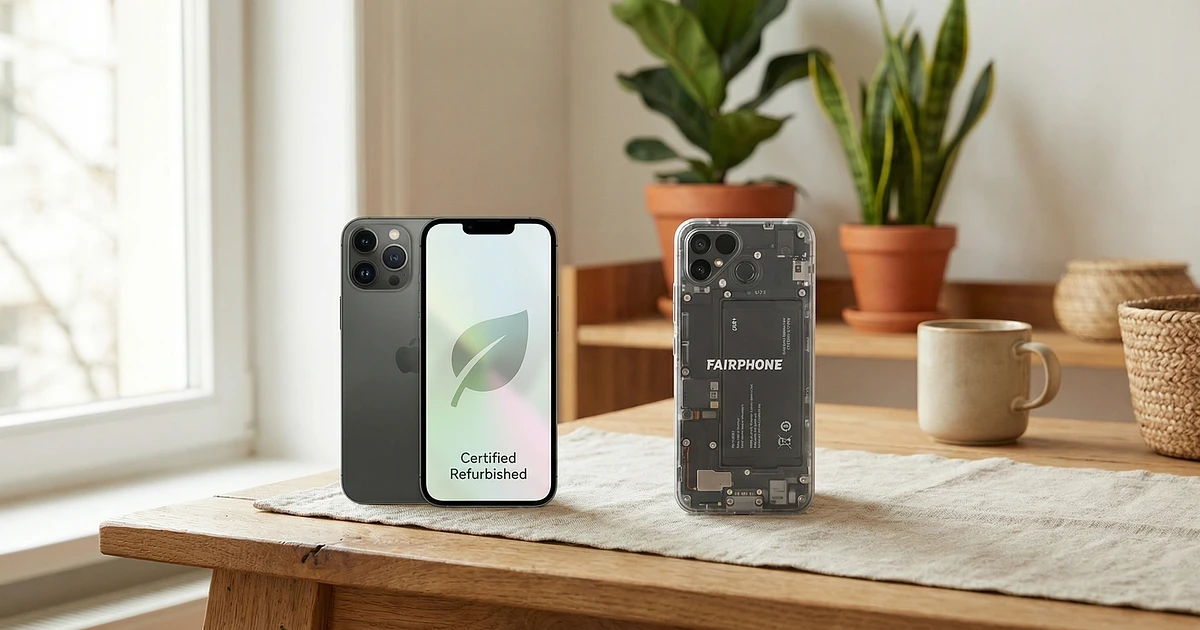

You want a sustainably produced smartphone that doesn't wreck the planet. Fair enough. But now you're facing a question that's surprisingly complicated: Refurbished iPhone for €369 or brand-new Fairphone 5 for €599?
Plot twist: The refurbished iPhone produces 15.7 kg of CO₂. The new Fairphone? 42.1 kg. 63% more emissions – from the device with the green image.
Before you close this tab and order a used iPhone, though: It's more complicated than that. And that's exactly what this guide is about – along with our comprehensive guide on buying sustainable electronics.
What Are Sustainable Smartphones?
Sustainable smartphones reduce environmental impact through extended usage, fair labor practices, or resource-efficient production. This includes refurbished devices that produce 78% less CO₂ than new ones, as well as fairly produced smartphones like Fairphone with conflict-free minerals and modular design for long lifespan.
Why This Question Is So Hard to Answer
Most guides split smartphones into two camps: mainstream manufacturers (bad, because new) and Fairphone (good, because fair). Or they recommend refurbished across the board without even mentioning Fairphone.
Both approaches are too simplistic.
Here's the thing: Sustainability has at least two dimensions.
Environmental: How much CO₂, water, and raw materials does a device consume over its lifecycle?
Ethical: Under what conditions was it made? Are workers paid fairly?
A refurbished iPhone scores well environmentally, but Apple has documented issues with labor conditions in its supply chain. Fairphone scores well ethically, but still produces a new device with all the associated emissions.
If you actually want to buy sustainable and eco-friendly, you need to understand both sides of the environmental equation.
What Makes Production So Problematic?
Before we compare different sustainable smartphones: Here's a number worth remembering: 78 to 80% of a smartphone's CO₂ emissions happen during production. Not while charging. Not during daily use. During manufacturing.
According to the Fairphone 5 lifecycle assessment, production accounts for 32.7 kg of CO₂ out of a total 42.1 kg over three years of use. The remaining footprint? Spread across transport, packaging, and charging energy.
This explains why extending device lifespan matters so much – and what refurbished really means for environmental impact. Every additional year a smartphone stays in use significantly lowers its annual carbon footprint.
(Not rocket science, but many people still don't think about it.)
A study from the Fraunhofer Institute IZM examined this in detail:
5 years instead of 3 years: 31% lower annual climate impact
7 years instead of 3 years: 44% lower annual climate impact
That's why both refurbished and Fairphone qualify as the most sustainable smartphone options on the market. Refurbished extends a device's first life. Fairphone enables an especially long life through modular design.
Sustainable Smartphones CO₂ Comparison: Refurbished vs. Fairphone
Enough theory. Let's look at numbers. How do different sustainable smartphones actually compare?
Refurbished iPhone 11
A study verified by Fraunhofer Austria shows that a refurbished iPhone 11 produces just 15.7 kg of CO₂ over its entire lifecycle. A new iPhone 11 would produce 72 kg.
The savings: 78% fewer emissions.
The reason is simple: The energy-intensive production already happened. The device exists. It's simply cleaned, tested, and repaired if needed. This refurbishment process uses only a fraction of the energy required for new production. This makes refurbished a key part of the circular economy in tech.
New Fairphone 5
The Fairphone 5 produces 42.1 kg of CO₂ over a baseline three-year usage period. That's significantly more than the refurbished iPhone, but less than many mainstream smartphones when bought new.
Fairphone has reduced its own CO₂ emissions by 48% since 2022, which is impressive. But physical reality remains: Manufacturing a new device consumes resources, regardless of how fair the supply chain is.
The Comparison Table
| Device | Total CO₂ Emissions | Source |
|---|---|---|
| Refurbished iPhone 11 | 15.7 kg | Fraunhofer Austria |
| New Fairphone 5 (3 years) | 42.1 kg | Fairphone LCA |
| New Fairphone 5 (5 years) | ~29 kg annual equivalent | Fraunhofer IZM |
| New iPhone 11 | 72 kg | Fraunhofer Austria |
At first glance? Clear win for refurbished. But wait. The Fairphone is designed to last 5 to 7 years – and that's where it gets interesting.
Fairphone's Trump Card: Longevity
Fairphone has an ace up its sleeve that simple CO₂ comparisons miss: The device is built for maximum lifespan.
What that means in practice:
Modular design: Battery, display, camera, speakers. You can replace everything yourself
5 years of software updates: Guaranteed Android updates (Apple offers this too, Samsung less so)
Spare parts available: Fairphone sells every component individually
DIY repairs: No special tools needed. iFixit gives it top marks
(Anyone who's ever tried replacing a glued Samsung battery knows to appreciate this.)
If you actually use a Fairphone 5 for 7 years instead of 3, the annual CO₂ footprint drops by 44% according to Fraunhofer IZM. That brings the effective total down to roughly 6 kg per year of use.
A refurbished iPhone 11 typically lasts another 2 to 3 years before running into performance issues or losing update support. Over 2 years of use, that's about 7.85 kg per year.
The result: With maximum usage duration, both sustainable smartphone options are nearly equal.
But Do People Actually Keep Smartphones That Long?
Nice theory. Problem is: Most people switch phones every 2.5 years. Fairphone's sustainable strategy only works if you actually keep the thing for 5 to 7 years.
Reality? Sobering:
Average usage duration in Germany: 2.5 years
51% let old phones rot in drawers
Only 8% recycle or sell
Fairphone hopes their buyers think differently. Maybe. They can't prove it. But the most sustainable choice depends on actual usage duration.
The Ethical Dimension: More Than Just CO₂
Fairphone now plays its strongest card: the supply chain. Sustainable smartphones must not only protect the environment, but also be produced fairly.
Fairphone is the only smartphone company that:
Uses Fair Trade gold and silver
Verifiably sources conflict-free minerals (cobalt, lithium, tin, tantalum)
Receives the best rating for worker rights (Utopia.de reports)
Fights for living wages throughout its supply chain
A refurbished iPhone doesn't change anything about how the original was produced. Labor conditions at Foxconn remain problematic, whether you buy the device new or used.
The Fairphone Community actively debates exactly this question: Is a lower carbon footprint more important than fair working conditions? The answer depends on your priorities.
Why Germany Lags Behind on Sustainable Smartphones
Only 25% of Germans have ever purchased a refurbished smartphone. Lowest rate in Europe.
The Wuppertal Institute found that Germany lags on sustainable smartphones, even though the European market is booming (80 million devices in 2023, 10% growth).
The good news: 81% of Germans who've bought refurbished once continue to do so. The problem isn't quality. It's initial skepticism.
What Germans Worry About
These concerns keep many Germans from sustainable smartphones:
- Battery health: Does the battery still hold a charge?
- Hidden defects: Are there scratches that weren't visible in photos? Our overview of refurbished condition grades explains what to expect at each level.
- Warranty: What happens if something breaks?
- Software updates: Will I still get security patches?
Those who buy sustainable smartphones used wonder: Is the quality trustworthy? Most of these concerns are unfounded, at least when buying from reputable sellers.
Quality Assurance: What Does Stiftung Warentest Say?
Stiftung Warentest tested 45 refurbished smartphones from 9 German retailers in 2023.
What they found:
6 of 9 retailers: "good" rating
7 devices better than advertised (pleasant surprise)
9 devices with defects (out of 45 tested – 20% rate)
Test winner rebuy.de: Grade 2.2, zero defects – learn more about rebuy.de in our retailer profile.
Bottom line: Refurbished works – when you buy from established retailers. This shows: All sustainable smartphone providers offer solid warranties. But quality varies by retailer.
On refurbito, you can compare all retailers with current prices and warranty conditions. Our detailed retailer comparison shows the differences in detail.
Warranty Comparison
| Retailer | Warranty | Special Features |
|---|---|---|
| rebuy.de | 36 months | Stiftung Warentest winner |
| Refurbed | 12+ months | B Corp certified, plants tree per device |
| Back Market | 12 months | Largest selection |
| Fairphone (new) | 5 years | With registration |
| Fairphone New Life Edition | 2-5 years | Refurbished Fairphones |
Total Cost of Ownership: The 5-Year Calculation
Fairphone's higher purchase price (€599) looks daunting compared to a refurbished iPhone 11 (around €369). But for sustainable smartphones, it's worth looking at total costs. How does the math work out over 5 years?
Scenario 1: Refurbished iPhone 11
| Item | Cost |
|---|---|
| Purchase | €369 |
| Battery replacement after 2 years (Apple Service) | ~€99 |
| New refurbished device after 3 years | €350 (estimated) |
| Total 5-year cost | ~€818 |
Assumption: The iPhone 11 lasts 3 years, then you need another refurbished device.
Scenario 2: New Fairphone 5
| Item | Cost |
|---|---|
| Purchase | €599 |
| Battery replacement after 3 years (DIY, ~€49) | €49 |
| No replacement device needed (5+ year use) | €0 |
| Total 5-year cost | ~€648 |
Assumption: The Fairphone lasts 5 years with one battery swap.
Surprise: Over 5 years, you save about €170 with Fairphone – if you really keep it that long.
The calculation is simplified. Real costs depend on your usage, repair needs, and prices at the time of purchase. But the point stands: Fairphone's higher entry price pays off long-term.
The Best Option: Refurbished Fairphone
There's one sustainable solution that combines the best of both worlds: A refurbished Fairphone.
Fairphone offers the New Life Edition with original spare parts, at least 80% battery capacity, and up to 5 years warranty.
What you get:
Lowest carbon footprint (no new production)
Fair supply chain (ethical manufacturing of the original device)
Modular design (long usage possible)
Warranty like new devices
The catch: Availability is limited. Older models like the Fairphone 4 New Life Edition cost around €400 but aren't always in stock.
This option combines all benefits of sustainable smartphones. You can compare sustainable smartphones on refurbito and find the best deals, including Fairphones when available. A detailed CO₂ analysis of refurbished devices shows environmental benefits in detail.
Buying Sustainable Smartphones: Which Option Fits You?
After everything we've analyzed, here's the honest recommendation. The right sustainable smartphone fits your usage pattern:
Buy Refurbished (iPhone, Samsung, etc.) if...
Lowest absolute CO₂ footprint is your priority
You have a limited budget
You want a new device every 2-3 years (because you'll switch anyway)
Latest features matter more than longevity
You buy from established retailers (rebuy.de, Refurbed, Back Market)
Recommended products: Refurbished iPhone 12/13, Samsung Galaxy S21/S22. One to two generations old, still long support. Our refurbished iPhone buying guide helps with model selection.
Buy a New Fairphone if...
Fair working conditions matter as much as environmental protection
You're willing to use the device for 5 to 7 years
You want to repair it yourself (battery, display, etc.)
You want to make a statement against throwaway culture
You want to change the industry (demand creates supply)
Recommended model: Fairphone 5 (current), wait for Fairphone 6 if announced
Buy a Refurbished Fairphone if...
You want both: lowest footprint and fair production
You have patience with availability
The model doesn't need to be brand new
Recommendation: Fairphone New Life Edition when available
Sustainable Smartphones: Key Takeaways
- Refurbished has the lowest absolute CO₂ footprint: 78% less than new
- Fairphone wins with long-term use: 5 to 7 years offset the higher production footprint
- Ethics is more than environment: Fair working conditions only come with Fairphone
- Refurbished quality is verified: Stiftung Warentest confirms this
- The best choice depends on you: Your usage duration, priorities, and budget decide
And ultimately, what Thea Kleinmagd from Fraunhofer IZM says holds true: "The best way to reduce the environmental impact of a phone is to make sure it can be used for as long as possible."
Whether that's a refurbished iPhone you use for three years or a Fairphone that lasts seven, is your decision.
The market for sustainable smartphones is growing, and every conscious purchase decision contributes to more sustainability in the tech industry. At refurbito, we compare prices for sustainable smartphones from the best retailers, so you can find the right choice for you.