Refurbished Wearables: What the NIQ Data Really Shows
 6 min read
Unit sales of refurbished wearables rose 53% in one year. The second figure attracts less attention but matters just as much: their share compared with new wearable unit volume moved from 2% to 3%. The category is growing quickly, from a small base.
How fast did refurbished wearables actually grow?
According to NIQ's report published on 30 April 2026, unit sales of refurbished wearables rose 53% from January through December 2025 compared with the previous year. Revenue increased 49%. At the same time, refurbished products moved from 2% to 3% of new-device unit volume within the category.
Units, revenue and share tell different parts of the story. The first two measure growth inside the refurbished category. Only the comparison with new-device volume shows how small that category remains.
| NIQ metric | 2025 versus 2024 | What it tells us |
|---|---|---|
| Refurbished wearables unit sales | +53% | More devices were sold |
| Refurbished wearables revenue | +49% | Category revenue increased |
| Share versus new devices | 2% to 3% | Growth came from a small base |
A market can grow quickly while remaining small. For a buyer, wider visibility is not evidence that any one listing is good.
Comparisons with other categories need the same measure. NIQ reports 2025 unit growth of 46% for refurbished tablets, 45% for laptops and 38% for smartphones. Their revenue figures were 42%, 31% and 36%. Our article on the German refurbished market in 2026 covers the broader picture.
Smartwatches and headphones: what NIQ does not show
NIQ's published release names only the combined category "wearables." It does not define which products sit inside that category on the page. There are no separate growth rates for smartwatches, fitness trackers, headphones or earbuds.
Putting smartwatches in the category may seem reasonable. It is still not a published smartwatch figure. The gap is larger for headphones because the release never mentions headphones, AirPods, earbuds or audio devices. Hartware's report from 30 April 2026 repeats NIQ's aggregate figures but supplies no product breakdown either.
NIQ's figure is useful for the combined category. Applying 53% to a smartwatch or headphone submarket would add data that the source never published.
From trade-in to resale
Where do used smartwatches enter this market? One visible route is Apple Trade In. Apple lists Watch as a trade-in category. Model, configuration and condition feed into an estimate, then Apple checks the device after receipt. The value may change if its condition differs. Apple says devices with no trade-in value can be recycled free of charge.
That documents an organised route for used smartwatches. Apple does not say on this page how many traded-in watches are later refurbished and resold.
Marketplaces create another route. Back Market describes data erasure, cleaning, restoration and device-specific checks within its own quality model, with smartwatches among the covered categories. The word "own" matters. These are the marketplace's process claims, not a universal industry standard.
Headphones are professionally refurbished too. Apple's German Certified Refurbished programme links to an AirPods category and describes functional testing, cleaning, inspection and original replacement parts where needed. The general programme page does not prove that a specific AirPods model is currently in stock.
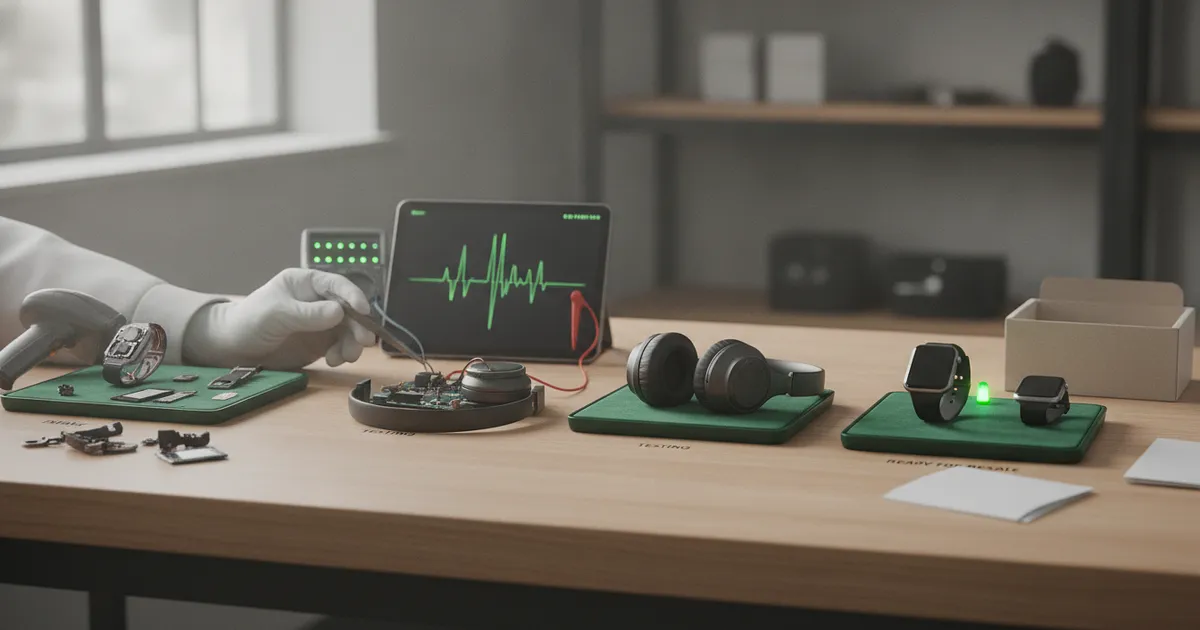
A watch or pair of headphones may therefore be checked, cleaned and repaired before returning to sale. The actual steps depend on the programme and seller.
Why can the market feel larger than its share suggests?
NIQ offers two clues for refurbished products overall. Its release dated 30 April 2026 says 90% of refurbished purchases happen online. It also says refurbished products cost roughly 15% to 25% less on average than comparable new devices. Neither figure is specific to wearables.
A small market can look busy online. Listings from different refurbishers sit next to each other, while manufacturer and trade-in programmes add more visible routes.
If you're ready to buy, battery condition, accessories and seller terms matter more than the growth rate. Hygiene and replacement parts matter for headphones too. Our guide to refurbished AirPods, Sony and Bose headphones covers those checks.
For watches, software support and sensors deserve a closer look. See our refurbished smartwatch buying guide for those questions.
What could change the resale channel next?
The European Commission says Member States must transpose the repair directive into national rules and apply it from 31 July 2026. The European repair platform is expected to become operational in January 2028.
Those changes could make repair and refurbishment easier over time. Their timing cannot explain NIQ's sales figures for 2025.
For now, 53% is the eye-catching number. The 3% share next to it matters just as much. Resale has clearly grown, but NIQ's published data does not reveal which individual devices drove it.
Frequently Asked Questions
How much did the refurbished wearables market grow in 2025?
NIQ reports 53% unit growth and 49% revenue growth in Germany compared with 2024. Their refurbished share relative to new-device unit volume rose from 2% to 3%.
Are headphones included in NIQ's wearables data?
The publication does not say. NIQ does not define the category on the page and never mentions headphones, AirPods or earbuds.
Does the 53% growth figure apply to smartwatches?
Not as a separately supported figure. NIQ publishes one rate for the combined wearables category and no smartwatch-specific result.
What does refurbished mean for a wearable device?
The process varies by seller. Programmes may include functional tests, data erasure, cleaning, repairs and condition grading. The reviewed sources do not establish one universal industry standard.
Is a refurbished smartwatch or pair of headphones worth buying?
That depends on the model, condition, battery, software support, accessories and seller terms. Market growth alone says nothing about the quality of a specific offer.