From iPhone to Shiftphone: A Personal Experiment
 9 min read
The battery indicator read 78%. My iPhone sent its usual warning: "Your battery's maximum capacity has declined." Three years old, already approaching end of life. A problem that led me directly to the question: Shiftphone vs Fairphone – which sustainable smartphone suits me?
I looked up the repair price. 99 euros for a battery replacement at Apple. Or I could just buy a new one. The current model costs only 1,199 euros. Plus a case. Plus new accessories.
That's when I asked myself for the first time: Does it have to be this way?
Why I wanted to leave Apple after ten years
Let me be honest: I wasn't an unhappy Apple user. The iPhone works. The integration with MacBook and Apple Watch is convenient. iMessage makes family group chats simple.
But something increasingly bothered me.
I researched what I'd long suspected: We produce 62 million tonnes of electronic waste annually. Only 17.4% gets properly recycled. Smartphones play a bigger role in this than I thought.
Then I read something surprising: Recycling wasn't the key issue. According to Deloitte, 85% of a smartphone's carbon footprint comes from manufacturing, not recycling. That led me to a clear conclusion: Using a device longer is more effective than disposing of it correctly.
My iPhone wasn't broken. It needed a new battery. But Apple deliberately makes self-repair difficult. And I didn't want to play along anymore.
Shiftphone Experience: Why I chose SHIFT
When you search for sustainable smartphones, two names come up quickly: Fairphone from the Netherlands and Shiftphone from Germany.
Both pursue similar goals. But there are differences.
Fairphone has a longer track record for software updates (eight to ten years guaranteed) and is better known. Shiftphone, on the other hand, excels at repairability. The modular smartphone Shiftphone 8 achieves 9.5 out of 10 points in iFixit's repairability score. No other smartphone comes close.
What convinced me: SHIFT is a family business without investors. All profits flow back into product development and sustainability projects. "We do as much good as we can while doing as little damage as possible," write founders Carsten and Samuel Waldeck.
That sounded like an experiment worth trying.
Week one: Chaos and surprises
My Shiftphone arrived in minimalist packaging. No high-gloss box like Apple's. But a screwdriver was included.
Setup was bumpier than expected. Google has developed a "Switch to Android" tool to simplify data transfer when switching from iPhone to Android. But some apps needed complete reconfiguration. Two-factor authentication for everything from scratch.
The biggest shock: No iMessage.
For Apple users, this isn't a small thing. Family and friend group chats had run through iMessage for years. Suddenly I received SMS instead of blue bubbles. Some message reactions came as separate texts: "Liked: Be there in 10 minutes."
The solution was simple but took time: Signal for family, Telegram for friends, WhatsApp for everyone else. Three apps instead of one. It works, but it's less elegant.
What I honestly miss
I won't sugarcoat this. There are real losses when switching. And yes, I'm not so set in my ways that I don't care. Sometimes I genuinely get frustrated by these losses.
AirDrop was convenient. Sending photos from phone to laptop takes longer now. I use Nextcloud instead, but it's an extra step.
The camera isn't at iPhone level. For social media and snapshots, it's perfectly fine. But if you care about night shots or portrait modes, you'll notice the difference.
Apple Watch compatibility doesn't exist. My Series 6 now sits in a drawer. That hurt.
The app ecosystem is smaller. Some banking apps don't work on ShiftOS-L (the Google-free version). I had to switch to the version with Google services.
Studies show that over 90% of iPhone users stay within the Apple ecosystem. I now understand why. The lock-in is real.
What positively surprised me
Then came the moment that changed everything.
After six weeks, I noticed the battery was declining. Before, I would have booked an appointment at the Apple Store. This time, I ordered a replacement battery for 29 euros.
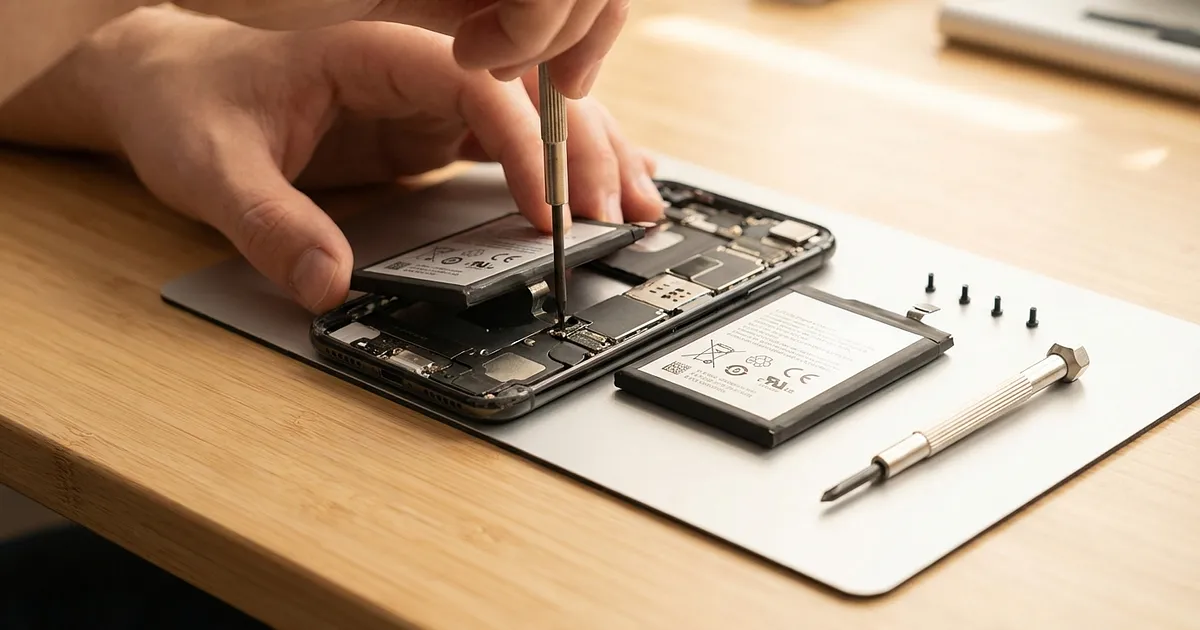
When the package arrived, I sat down at my kitchen table. Screwdriver out, four screws loose, back cover off, old battery out, new one in. Done.
Five minutes. No waiting. No appointment. No Genius Bar.
I owned six iPhones over ten years and never opened one. Apple makes opening them void your warranty. The Shiftphone's repairability is the normal case.
That sounds like a small thing. It isn't. The Shiftphone's repairability changes your relationship with the device. You actually own it, rather than just using it.
Hardware kill switches
The Shiftphone has physical switches that disconnect the microphone and camera at the hardware level. No app, no hack can bypass this. This hardware feature provides real privacy. For someone who never saw themselves as paranoid, it feels surprisingly reassuring.
The community
The Shiftphone community in the forum is different from Apple forums. Less fanboy culture, more practical exchange. People help each other with repairs and share honest experiences.
Some users report problems. Display durability on the older Shift6mq was an issue. Battery problems with early Shiftphone 8 deliveries too. People don't hide this. They discuss solutions.
The truth about sustainable tech
Let me tell you this because it was an important realization: Perfect sustainability doesn't exist. There's only less bad. Let me tell you something uncomfortable: Sustainable smartphones like the Shiftphone aren't perfect. The modular smartphone offers solutions, but not magic ones.
The Shiftphone is manufactured in China. SHIFT operates its own factory there with fair wages and transparent working conditions, but it's still China. Not everything is fair-trade certified.
The difference from Apple lies not in the "where" but in the "how." SHIFT publishes budget breakdowns, just like Fairphone. You see exactly where the money goes – wages, materials, research. Apple doesn't do that. It's not perfect, but it's a start.
According to a recent survey, over 70% of buyers consider sustainability an important factor. But only a few actually switch. The platform switching rate is 18%, with about half being iPhone users moving to Android.
That shows: The switch is possible. But it requires a conscious decision.
Who would I recommend the Shiftphone to?
Honestly: Not everyone. I didn't become a DIY person along the way, I had to become one. That only works if certain things matter to you.
The switch would make sense for you if repairability really counts and you prefer a modular smartphone like the Shiftphone where you can work on it yourself. (Battery replacement is trivial, but it takes psychological effort the first time.)
If sustainability drives a real purchase decision, not just a good feeling when shopping. The Shiftphone isn't a lifestyle statement, it's an actual reduction in e-waste.
If you're not deeply embedded in the Apple ecosystem. With Apple Watch, AirDrop, and iMessage, you've already made your choice. The switch will be painful.
And yes: If perfection matters less to you than control. The Shiftphone is less polished. Some things require workarounds. If that doesn't annoy you but intrigues you, then it's for you.
I'm not one of those tech evangelists. I'm someone who wanted something different after ten years. That's the only reason I know.
The Shiftphone doesn't suit you if:
Camera quality is your most important criterion
You use Apple Watch and AirPods daily
You don't want to deal with app alternatives
You just want a device that "just works" without setup effort
If that keeps you on iPhone, the catalogue holds a reconditioned one: Apple iPhone 15 128GB schwarz, graded very good — a refurbished alternative, not a repairable-by-design phone like the Shiftphone.
Affiliate link. Buying through it earns us a commission; the price stays the same for you.
My verdict after three months
Do I regret the switch? No.
Would I recommend everyone do the same? Also no.
The Shiftphone isn't a better iPhone. It's a different concept. The shift to more repairability means: Less throwaway mentality, more responsibility. Less predetermined, more conscious.
As tech reviewer Pete Matheson writes: "Choose whichever platform makes you happy and suits your lifestyle." The switch doesn't have to be permanent. It can be an experiment.
Mine has been running for three months. The battery holds. The camera is sufficient. And if something breaks, I fix it myself.
That feels good.
All products from this post
The ones we named above are marked; the rest are alternatives in the same category.
Affiliate notice: As an Amazon Associate, we earn from qualifying purchases. Product prices and availability are subject to change.
Frequently Asked Questions
Is Shiftphone or Fairphone better?
Fairphone thinks long-term: eight to ten years of software updates and better known. Shiftphone thinks radical: With 9.5/10 repairability (no other smartphone comes close) and a philosophy where the user has real ownership, not just a lease.
If software longevity matters to you, take Fairphone. If modularity matters – if you want to know you can repair your phone yourself – take Shiftphone.
Can I transfer my data from iPhone to Shiftphone?
Yes, but with limitations. Google's "Switch to Android" tool helps with contacts, photos, and calendars. Apps need to be reconfigured, especially those with two-factor authentication. iMessage group chats no longer work. Plan about two to three hours for complete setup.
How long does a Shiftphone last compared to an iPhone?
Potentially longer due to the modular design and high repairability. While iPhone batteries often have problems after three years and replacement is cumbersome, you can swap the Shiftphone battery yourself in five minutes. With normal use and occasional repairs, five to seven years is realistic.
Does WhatsApp work on the Shiftphone?
Yes, on the ShiftOS-G version (with Google services). On ShiftOS-L (Google-free), you have to decide whether you prefer the offline ideal or the functional messaging app. (Spoiler: I chose functional.)
Banking apps and some Google-dependent services don't work or work only partially on the L version.
Is switching from iPhone really worth it?
That depends on your priorities. If sustainability and repairability matter to you and you're not heavily dependent on Apple Watch, AirDrop, and iMessage, the switch can make sense. If camera quality and seamless integration mean everything to you, you'll have to make compromises.
Honest advice: Try it as an experiment, not as a final decision. My Shiftphone experience after three months shows: It's doable, but requires conscious adjustment.
Sources
- 62 million tonnes of electronic waste theroundup.org
- According to Deloitte deloitte.com
- Shiftphone 8 achieves 9.5 out of 10 points editorialge.com
- SHIFT is a family business without investors shift.eco
- "Switch to Android" tool blog.google
- Studies show businessmodelhacking.com
- Shiftphone community in the forum forum.shiftphones.com
- According to a recent survey ramhee.com
- The platform switching rate alibaba.com
- As tech reviewer Pete Matheson writes petematheson.com