Refurbished Phone Environmental Impact: What the CO2 Numbers Actually Show
 8 min read
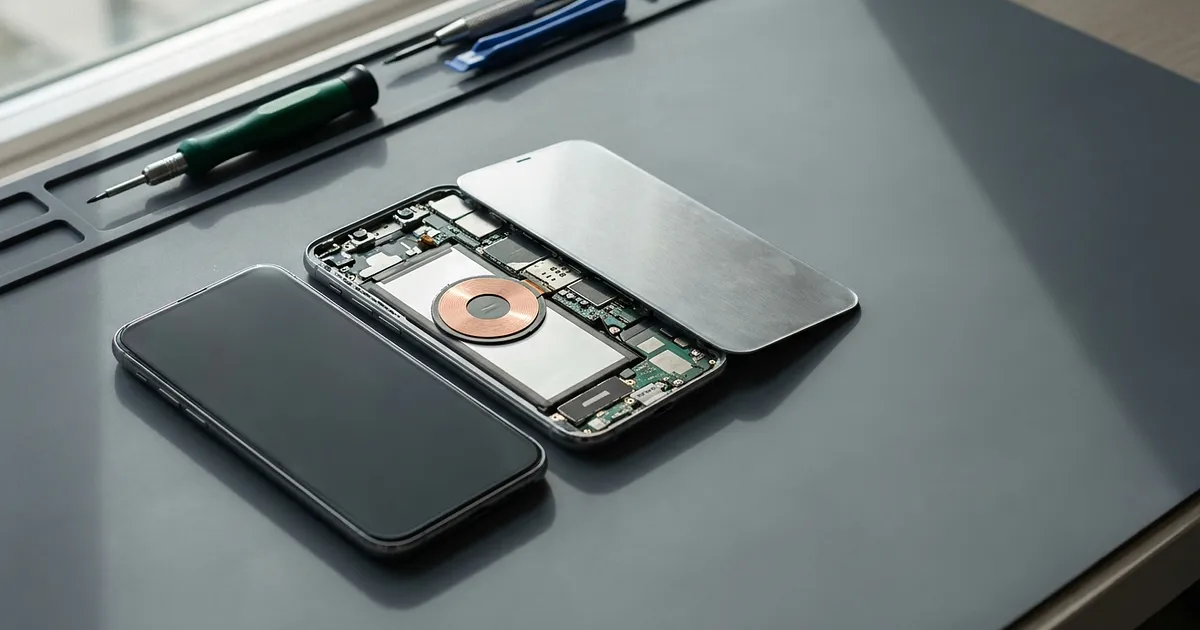
Bring up a refurbished phone's carbon footprint and most people jump straight to packaging, shipping and recycling. The real lever sits elsewhere: on a factory floor. Making one new smartphone releases roughly 47 kg of CO2 according to the German Federal Environment Agency (Umweltbundesamt) (as of 07/2023), about as much as 432 single-use plastic bottles, all before the device touches a charging cable.
What a new phone costs the environment before you switch it on
"Longer use has a positive effect on a phone's CO2 balance," says Anna Zagorski, a green-IT specialist at the German Federal Environment Agency, in an interview with Stiftung Warentest (22.02.2023). Sounds obvious. It isn't.
For a smartphone, manufacturing dominates, not operation: a study by the EU's Joint Research Centre (Cordella et al., 2021) assigns roughly three quarters of the annual footprint (about 10.7 kg CO2e) to production, mostly circuit board, display and chips. Electricity from your wall socket barely registers.
And the 47 kg? Not a law of nature.
Life-cycle assessments vary by model, system boundary and study year: the Fairphone 4 assessment supported by Fraunhofer IZM (03.05.2022) puts that device's full life cycle at 43 kg CO2e. Anyone selling a single "the" CO2 value for a smartphone is oversimplifying.
What a refurbished phone's environmental impact avoids
The most solid figure comes out of France: a refurbished smartphone avoids 82 kg of raw material extraction and 23 kg of greenhouse gases per year compared with a new device, an 87 percent drop in climate impact, per that ADEME life-cycle assessment (19.01.2022).
The underlying ADEME study (09/2022) puts the avoided environmental impact at 64 to 87 percent depending on the product category. Not an advertising promise.
The EU's Joint Research Centre (Cordella et al., 2021) agrees: stretch a replacement cycle from 2 to 3 years and the smartphone's carbon footprint drops 23 to 30 percent; replace a new device 1:1 with a used one and 52 to 79 percent becomes possible.
Industry numbers exist too, and deserve that label. Refurbed commissioned Fraunhofer Austria to run a life-cycle assessment (pilot 2023, expanded 2024): a refurbished iPhone 12 with 128GB reports 82 percent less CO2 and 76 percent less e-waste. Independent institute, interested client, both true at once.
How much money that saves lives in our comparison of refurbished and new-device prices; this is about CO2, not euros. Whether a brand-new Fairphone wins instead is settled in the sustainable smartphone comparison: Refurbished vs. Fairphone.
The rebound effect almost nobody writes about
Now the uncomfortable part. A peer-reviewed study in Frontiers in Energy Research (Makov & Font Vivanco, 2018) found that on average 29 percent of the expected CO2 savings from smartphone reuse gets cancelled out by a rebound effect, ranging 27 to 46 percent by iPhone model. Money saved gets spent elsewhere, or the purchase doesn't fully replace a new one.
Honestly, nobody knows how large that effect is in Germany in 2026. The study measured the US market and dates from 2018, so you can't simply subtract its 29 percent from ADEME's 87 percent. Direction still holds: real benefit sits below lab value.
Shipping, battery swaps and the rest of the honest balance
A refurbished device isn't emission-free: it carries a share of its original production, plus testing, cleaning, spare parts and transport. The ADEME study (09/2022) states plainly that environmental impact varies within the industry by a factor of 2 to 11, depending on device lifespan, packaging, spare parts, component origin and refurbishing location.
Batteries have just moved. Since 20 June 2025, under the EU Ecodesign Regulation 2023/1670, new smartphones sold in the EU must retain at least 80 percent of battery capacity after 800 charge cycles, and manufacturers must supply spare parts for up to 7 years, a more predictable parts supply for refurbishers. What's coming next for battery replacement is covered in Phone Battery Replacement: Right to Repair Arrives in 2027.
The phone in your pocket beats any purchase
The most uncomfortable number comes last: the Fairphone 4 life-cycle assessment (03.05.2022) shows that using a smartphone 5 years instead of 3 cuts its annual CO2 footprint by 31 percent, and stretching to 7 years, including two battery replacements, gets 44 percent.
No purchase, no shipping, no refurbishing.
If your phone still works, keeping it is the greenest option, by a wide margin. Nursing the battery through those extra years is covered in our battery care tips.
When you genuinely do need a replacement device
At some point a device really is finished: the display cracked, or security updates stopped coming. Order of preference: refurbished before brand new. We compare offers, sell nothing ourselves: here are two snapshots from one retailer's stock. That pile's size is covered in 300 Million Old Phones in German Drawers, one more reason to check refurbished listings first.
iPhone 15 Pro, refurbished
The German retailer asgoodasnew lists the Apple iPhone 15 Pro 128GB Titan blau in condition "sehr gut" (very good) for 579.00 euros, as of 13.08.2026. Both come from the retailer and shift quickly in this market. What grades like "sehr gut" or "wie neu" actually mean is covered in our refurbished condition grades explained guide.
Apple iPhone 15 Pro 128GB Titan blau
View at asgoodasnewAffiliate link. Buying through it earns us a commission; the price stays the same for you.
Galaxy S24 as the Android counterpart
At asgoodasnew, the Samsung Galaxy S24 128GB onyx black appears in condition "sehr gut" (very good) at 389.00 euros, as of 13.08.2026, the retailer's own grade too.
Samsung Galaxy S24 128GB onyx black
View at asgoodasnewAffiliate link. Buying through it earns us a commission; the price stays the same for you.
195 million phones sitting in drawers
German households hold around 195 million unused old mobile phones according to Bitkom (02.04.2025). Little of it gets collected: the German Environment Agency reports a 29.5 percent collection rate for 2023 (as of 04.06.2026), far below the 65 percent EU target in force since 2019. Globally, about 62 million tonnes of e-waste were generated in 2022, only 22.3 percent properly collected and recycled, per the Global E-waste Monitor 2024.
Every device that returns to circulation is one nobody has to build new. What that drawer is worth in raw materials gets calculated in 195 Million Unused Phones, and for a device that genuinely can't be saved, the environmental ranking of disposal routes sorts the options.
What's left of all this
A refurbished phone's environmental impact is a lever, not a free pass. The order of magnitude holds: 64 to 87 percent avoided per ADEME is measured, not marketed. Next to it sit a rebound effect, a factor 2 to 11 spread between providers, and the truth that not buying still wins.
If you genuinely have to replace a device, compare the certified providers side by side instead of trusting a retailer's first percentage. That's what this comparison exists for.
All products from this post
The ones we named above are marked; the rest are alternatives in the same category.
Affiliate notice: As an Amazon Associate, we earn from qualifying purchases. Product prices and availability are subject to change.
Frequently Asked Questions
How much CO2 does a refurbished phone save compared with a new one?
According to ADEME's life-cycle assessment (19.01.2022), a refurbished smartphone avoids roughly 82 kg of raw material extraction and 23 kg of greenhouse gases per year, an 87 percent cut in climate impact. Its 09/2022 study gives a range of 64 to 87 percent across product categories; there's no exact per-device figure.
What causes more emissions, manufacturing or use?
Manufacturing, by a wide margin. The German Federal Environment Agency puts a new smartphone's production (as of 07/2023) at roughly 47 kg CO2; the EU's Joint Research Centre assigns about three quarters of the annual footprint to production. Day-to-day electricity use barely registers.
Is a refurbished smartphone really better for the environment?
Compared with a new device, yes, clearly; compared with the phone you already own, no. The Fairphone 4 assessment (03.05.2022) shows that keeping a phone 5 years instead of 3 cuts its annual footprint by 31 percent, with no purchase. Refurbished wins once a replacement is happening anyway.
What is the rebound effect when buying refurbished?
Part of the expected saving disappears: money saved gets spent elsewhere, or a second-hand purchase doesn't fully replace a new one. A peer-reviewed study in Frontiers in Energy Research (Makov & Font Vivanco, 2018) puts it at 29 percent on average for the US market, 27 to 46 percent depending on the iPhone model.
How long should you keep a phone?
As long as it works. The EU's Joint Research Centre finds that one extra year, 3 instead of 2, cuts the carbon footprint by 23 to 30 percent. Since 20 June 2025, EU smartphones must hold 80 percent battery capacity after 800 charge cycles, making long use more realistic.
Sources
- German Federal Environment Agency (Umweltbundesamt) umweltbundesamt.de
- life-cycle assessment by the French environment agency ADEME theconversation.com
- in an interview with Stiftung Warentest test.de
- study by the EU's Joint Research Centre publications.jrc.ec.europa.eu
- Fairphone 4 assessment supported by Fraunhofer IZM izm.fraunhofer.de
- ADEME study librairie.ademe.fr
- Fraunhofer Austria to run a life-cycle assessment refurbed.de
- peer-reviewed study in Frontiers in Energy Research frontiersin.org
- EU Ecodesign Regulation 2023/1670 repair.eu
- Bitkom bitkom.org
- German Environment Agency umweltbundesamt.de
- Global E-waste Monitor 2024 unitar.org